Asetukset
 Nopea toimitus
 Ilmainen toimitus
 Incoterms
 Maksutyypit


 Markkinapaikan tuote

Use Innovative Intelligent Link Modules to Deliver Field-Level Data Transparency in Industrial Automation
Julkaisija DigiKeyn kirjoittajat Pohjois-Amerikassa
2026-02-03
Industrial automation designers have a powerful innovation at their disposal: an intelligent link module (ILM) that can connect a standard circuit breaker and a contactor to create an intelligent digital load feeder for starting motors and other electric distribution applications. It’s suitable for new installations or retrofits.
The ILM transforms conventional switchgear into an intelligent device for switching, protection, and control, plus real-time monitoring of voltage, current, phase asymmetry, overload events, and more. The integrated diagnostic functions speed error correction and support predictive maintenance, improving reliability and uptime.
The ILM system is highly flexible and can be used with a variety of circuit breakers and contactors. In addition, pre-assembled intelligent load feeders (ILFs) using an ILM are available up to 20 HP and 460 V. A second distributed I/O module supports network-wide digitization, data transparency, and performance optimization.
Siemens offers 50,000 module combinations for designers to create comprehensive digitalization solutions from the field to the cloud. The product line includes the recently introduced ILMs and complementary scalable and flexible distributed I/O system modules.
The Siemens SIRIUS Modular System provides a vast and harmonized family of tested and approved device combinations, ensuring compatibility and reliability for worldwide deployment. Components are available to cover virtually all industrial control applications, from simple switching to complex motor protection and monitoring (Figure 1).
 Figure 1: The Siemens SIRIUS modular system is a comprehensive, flexible, and space-saving portfolio of industrial control components for a wide array of applications. (Image source: Siemens)
Transparency down to the field level is becoming increasingly important, but not all devices are connected to the automation network. That means important data can be missing. Siemens' innovative SIRIUS 3RC7 ILMs change that.
While the overall SIRIUS modular system spans several standard sizes (S00 to S12) and includes devices that can handle up to 250 kW, the innovative 3RC7 ILMs are designed for use in small- to-medium-sized applications up to about 15 kW and in frame sizes S00 and S0. That’s precisely the range of applications most often neglected when capturing performance data at the field device level.
ILMs are suited for a wide variety of applications, including conveyor systems, mixing and crushing operations, ventilation and pumping equipment, electrical distribution transformers, gas discharge lamps, and similar devices.
Siemens offers ILMs with high-feature designs that include hybrid switching technology combining power semiconductors for controlled motor starting and stopping, and relays for continuous operation and energy savings. The result is increased durability, higher energy efficiency, and reduced maintenance.
High-feature ILMs also provide enhanced energy monitoring functionality beyond the standard version, including measuring phase voltage, power, and power factor of the connected load.
ILMs are available that support one-direction motor starting (direct models) and two-direction motor starting (reversing models). Model 3RC71401EE10 is an example of a high-feature direct module rated for 0.4 A to 4 A and up to 690 VAC in frame size S00.
Reversing modules manage two contactors using integrated logic to handle the sequence and interlocking of both contactors as required for changing motor direction, simplifying programming of the programmable logic controller (PLC). Model 3RC71414EE11 is a reversing starter with hybrid switching, rated for 3.5 A to 32 A at up to 690 VAC, in frame size S0 (Figure 2).
 Figure 2: ILM size S0 reversing starter with hybrid switching. (Image source: Siemens)
Push-in connections
The push-in connectors used with ILMs and other devices provide faster, more reliable, and vibration-resistant wiring. They also reduce installation time and improve system availability. Three of their numerous benefits include:
- Installation is sped up because wires, especially those with ferrules, can be inserted directly without tools, reducing wiring time by up to 50% compared with screw terminals.
- Front-entry wiring enables higher wiring densities in control cabinets and more compact solutions.
- The spring-loaded mechanism provides consistent pressure, eliminating the potential for under- or over-tightening associated with screw connections. The spring-loaded mechanism also provides a consistently strong and secure connection that is resistant to vibration. That eliminates the need for periodic checking and retightening required by screw terminals, ensuring continuous, reliable operation (Figure 3).
 Figure 3: Siemens ILMs use spring-type connector technology that’s strong, highly vibration-resistant, and supports rapid installation. (Image source: Siemens)
In retrofit applications, it’s essential to confirm that the existing components use spring-type connector technology to ensure compatibility with the 3RC7 ILMs.
In addition to using the SIRIUS 3RC7 ILMs to build digitized solutions, the ILMs are available as part of complete, pre-assembled units. These fully wired and mechanically connected assemblies are called intelligent load feeders (ILFs).
Intelligent load feeders
An ILF consists of a 3RC7 ILM plus the required contactor and motor protection circuit breaker. ILFs are available for direct starting or for reversing applications.
For example, the 3RA84121EE10 intelligent high-feature load feeder direct starter is rated for 0.4 A to 4 A up to 690 VAC. It’s in a frame size S00 and consists of a 3RC7140-1EE10 ILM, a 3RV2311-1EC20 circuit breaker, and a 3RT2017-2BB42 contactor (Figure 4).
 Figure 4: Exploded views of size S00 (left) and S0 (middle), and a model 3RA8412-1EE10 size 00 completed 3RA8 intelligent load feeder assembly (right). (Image source: Siemens)
ILFs can be used where combinations of motor starter protectors, contactors, and overload relays have been used in the past. They provide a fast, simplified way to modernize and digitize operations. Both the 3RC7 ILMs and the 3RA8 ILFs can be quickly integrated into control cabinets using SIMATIC ET 200 I/O systems.
Network integration
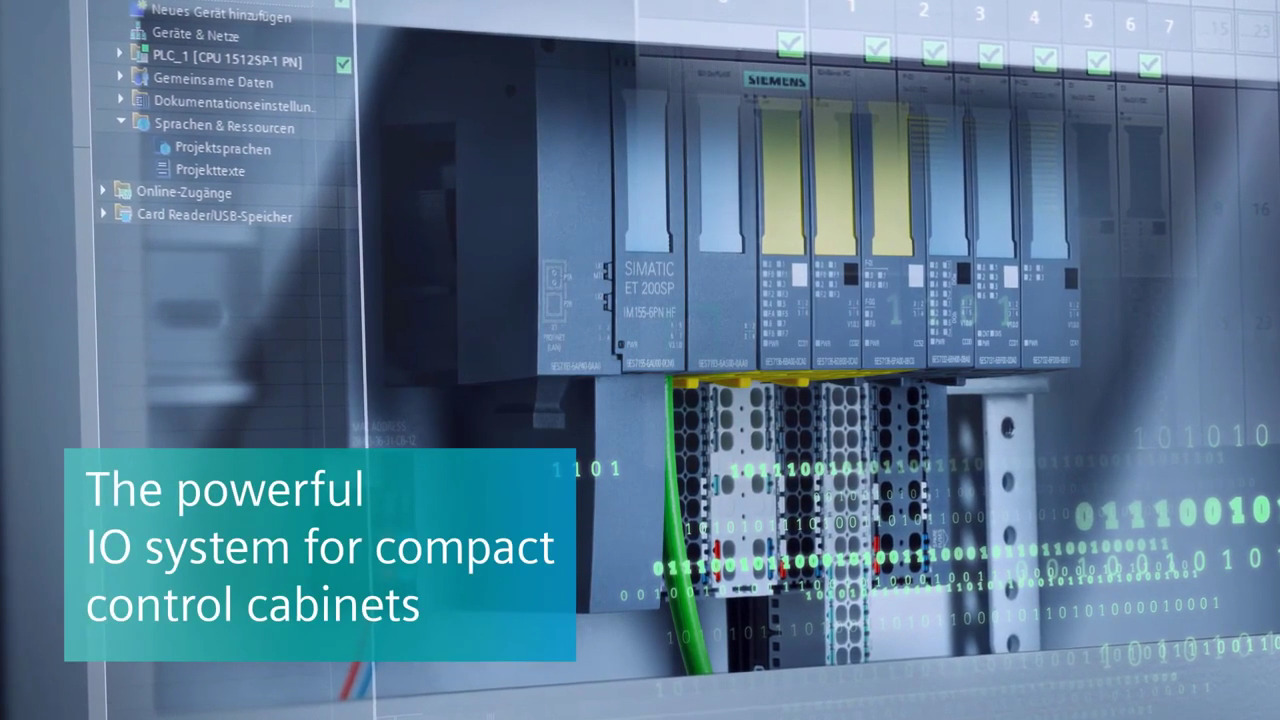
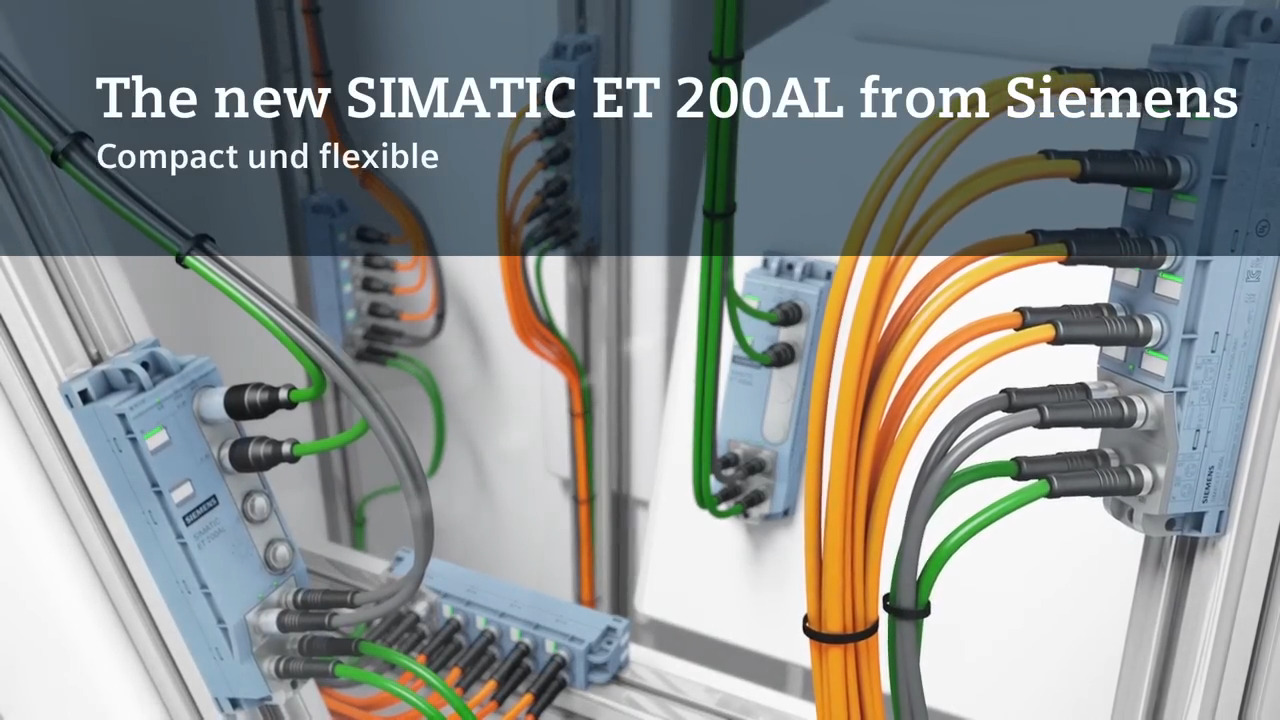
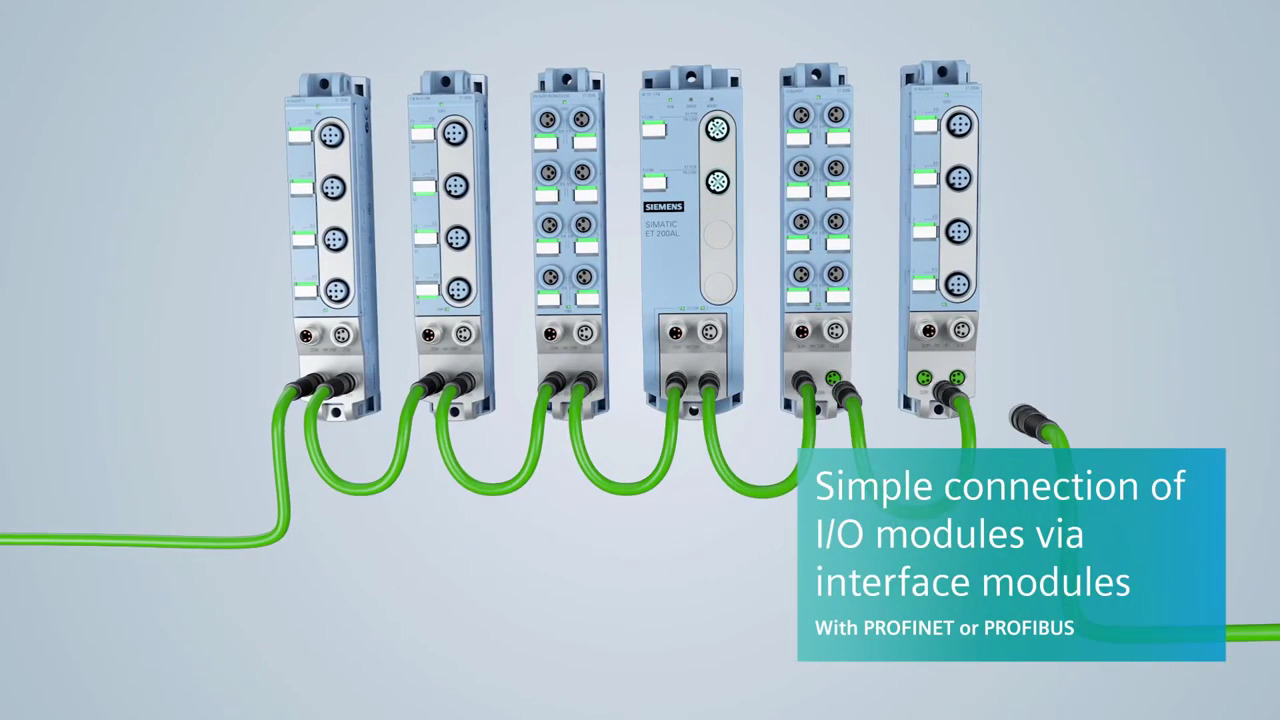
ET 200 I/O systems, like ET 200SP, ET 200MP, and ET 200pro, are specific product families within the SIMATIC ET 200 Platform. Each product family is tailored for different needs, such as control cabinets (ET 200SP/MP) or field installations (ET 200AL/pro), with varying performance, density, and environmental ruggedness requirements.
For example, the ET 200SP, with its compact design and push-in connector technology, is well-suited for use with ILMs and ILFs. Features include enhanced diagnostics capability for faster troubleshooting and module hot swapping for high availability. It’s also highly scalable. Up to 16 ILMs can be daisy-chained in series.
The 3RC7 ILM is designed for modern, connected control panels and supports multi-protocol communication over Ethernet. Supported protocols include PROFINET, EtherNet/IP, Modbus TCP, and OPC UA.
The rack-mounted ET 200SP operates as a gateway, collecting data from the ILMs. Data is sent to the PLC via an ET 200SP interface module that bridges the gap between field devices like ILMs, the control and operational (OT) network, and the information (IT) network. That supports more granular, real-time insights into field-level device performance (Figure 5).
 Figure 5: The SIMATIC ET 200SP I/O platform (bottom center) can connect SIRIUS ILMs or ILFs (bottom right) to OT and IT networks. (Image source: Siemens)
Fast installation
Once the decision has been made to add data transparency to field devices, the SIMATIC ILMs and ILFs, combined with the ET 200 I/O platform, support fast and flexible installation and commissioning. That enables the organization to reap the benefits of increased data availability rapidly.
Cables for connecting ILMs and ILFs are available in three lengths, 0.75 m, 1.5 m, and 2 m, to support control cabinet flexibility. Installation flexibility is further supported with 0.5 m, 2 m, 5 m, and 10 m cables for connecting ILMs and ILFs with ET 200 controllers.
Siemens’ Totally Integrated Automation (TIA) Portal is the company’s project planning and programming environment for automation, visualization, and drive technology. Network designers, machine builders, and installers can use it to quickly and easily parameterize, integrate, and commission SIRIUS 3RC7 ILMs and 3RA8 ILFs.
Flexible commissioning
The TIA Portal is useful in both new installations (greenfield projects) and in retrofitting or modernization projects for existing systems (brownfield projects). For new systems, TIA Portal provides an integrated engineering framework for the entire automation process, from digital planning to operation.
It combines several software tools into a single, seamless platform, which helps reduce engineering time and costs. The simulation and virtual commissioning tools use a digital twin to speed up on-site commissioning time.
TIA Portal can also accelerate retrofitting and modernization projects, including tools and services that support the migration and integration of legacy systems. Machines that previously lacked connectivity can be retrofitted using TIA Portal components to integrate them into modern IT/OT networks.
Backward compatibility enhances flexibility and can be used to unlock access to all previous versions of TIA Portal and enable designers to work with older projects in their native environments if a full migration is not immediately feasible.
Conclusion
Siemens ILMs and pre-assembled ILFs provide industrial network designers with innovative tools for bridging the gap between field-level devices such as motors and switchgear and higher OT/IT network levels. They provide highly reliable and flexible solutions for both greenfield and brownfield projects. Those solutions deliver real-time data to support system transparency, diagnostics, predictive maintenance, and overall system transparency within the TIA Portal.
Recommended reading:
- How to Use Compact PLCs to Get Big Results in Green Energy, Building Automation, and Industrial Systems
- What are Some Key Considerations When Selecting Industrial Automation Equipment?
- Using Temperature Controllers and Micro PLCs to Speed Small-Scale Automation Projects
- Using Cybersecure PLCs with Integrated Safety for High-Speed Industrial Automation
- Meeting the Challenges of EMI Control and Safety in Compact Industrial Control Panels

Disclaimer: The opinions, beliefs, and viewpoints expressed by the various authors and/or forum participants on this website do not necessarily reflect the opinions, beliefs, and viewpoints of DigiKey or official policies of DigiKey.