Asetukset
 Nopea toimitus
 Ilmainen toimitus
 Incoterms
 Maksutyypit


 Markkinapaikan tuote

Valm. osa # ABX00162
ARDUINO UNO Q 2GB RAM 16GB EMMC
Arduino

License: GNU Lesser General Public License Arduino
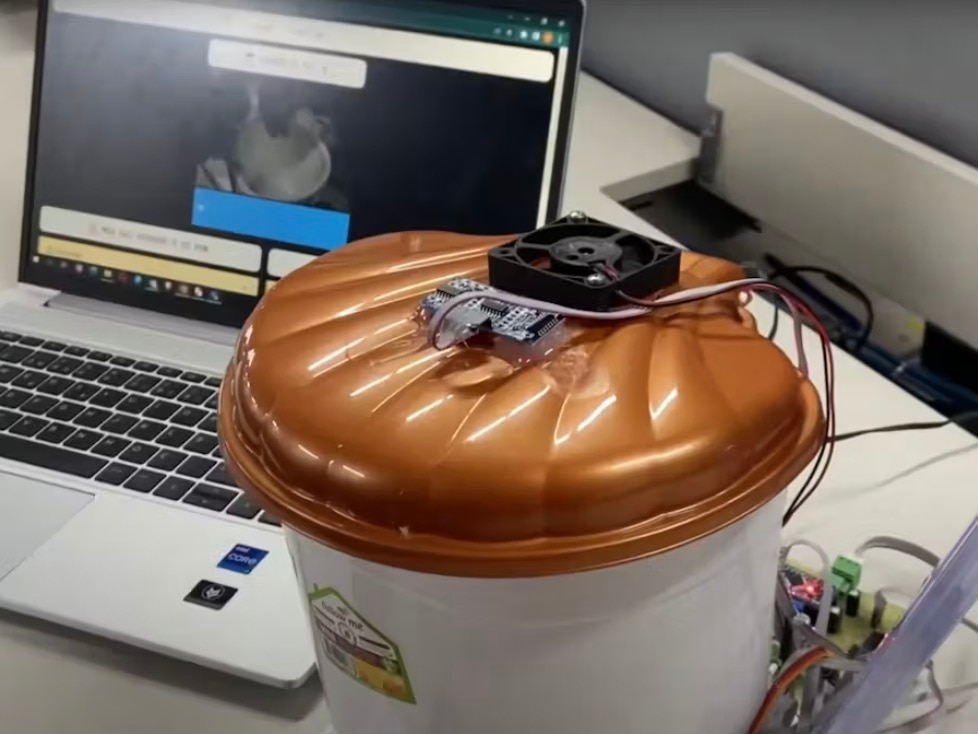
Waste segregation is one of the simplest ways to improve recycling efficiency, yet it is often overlooked in everyday life. Mixing paper, plastic, cardboard, and batteries in the same container makes recycling more difficult and can lead to environmental contamination. In this project, we build an AI-powered waste segregation system that automatically identifies common waste materials and directs them to the appropriate collection area.
Using an Arduino UNO Q, a USB camera, and an object detection model trained with Edge Impulse, the system recognizes different waste categories in real time. Once an item is identified, a servo motor directs it to the correct bin, while hazardous items such as batteries trigger an audible warning.
The Automatic Waste Segregation System project combines embedded hardware with computer vision to create a compact automated sorting system.
A USB camera continuously captures images of incoming waste items. These images are processed using an object detection model trained to recognize four categories:
Paper
Cardboard
Plastic
Battery
The trained model runs through the Arduino App Lab environment and analyzes each video frame. To improve reliability, detections must appear consistently across multiple frames before the system takes action. This reduces false triggers caused by lighting variations, object movement, or temporary misclassifications.
Once a valid detection is confirmed, commands are sent to the Arduino UNO Q through RouterBridge. The microcontroller then controls a servo motor or buzzer based on the detected waste type.
The sorting mechanism is intentionally simple and easy to reproduce.
When paper or cardboard is detected, the servo rotates toward the biodegradable waste compartment. After a short delay, it returns to its neutral position.
When plastic is detected, the servo rotates in the opposite direction, guiding the item into the non-biodegradable collection area.
Battery detection follows a different workflow. Instead of moving the servo, the system activates a buzzer to alert the user that a hazardous item has been identified. This helps prevent improper disposal of batteries, which can release harmful chemicals into the environment.
The project can be assembled using commonly available components:
Cardboard or 3D-printed sorting enclosure
Computer for model training and deployment
The servo motor serves as the physical sorting mechanism, while the buzzer provides safety notifications for hazardous waste.
The intelligence behind the project comes from a custom object detection model created using Edge Impulse.
The workflow begins by collecting images of the target waste categories. These images are labeled and used to train a machine learning model capable of recognizing different materials. After training, the optimized model is deployed for real-time inference.
By leveraging machine learning instead of traditional sensors, the system can distinguish visually different objects without requiring separate detection hardware for each material type.
The software is divided into two layers.
The Python application handles video capture, object detection, confidence evaluation, and decision-making. It continuously analyzes camera frames and determines when a detection is reliable enough to trigger an action.
The Arduino firmware manages hardware control. It receives commands from the Python application and executes functions such as:
Rotating the servo to a specific angle
Returning the servo to its default position
Activating the buzzer for a defined duration
This separation keeps the microcontroller focused on hardware control while allowing the computer vision workload to run efficiently on the host system.
One challenge in computer vision projects is preventing repeated or accidental activations.
To address this, the system implements:
Confidence thresholds for each waste category
Consecutive frame validation
Cooldown timers between actions
Detection debouncing
These techniques ensure that sorting actions occur only when the system is confident about the identified object.
Although designed as a demonstration project, the same concept can be expanded for larger waste management applications, including:
Smart recycling bins
Educational STEM projects
School and university demonstrations
Community recycling programs
Small-scale automated waste collection systems
The project also provides a practical introduction to machine learning at the edge, embedded control systems, and real-world computer vision applications.
This project demonstrates how embedded AI can be applied to everyday environmental challenges. By combining computer vision, machine learning, and simple electromechanical control, the system can automatically identify and sort common waste materials with minimal user intervention.
Whether you're exploring Edge AI, learning about object detection, or building a sustainability-focused project, this Automatic Waste Segregation System offers an excellent hands-on example of how intelligent automation can improve recycling and resource management.